RayXact
Construction Rotary Laser Level
Construction Rotary Laser Level
Couldn't load pickup availability
Built for Grading, Excavation, Drainage & Site Preparation
The first sign that a standard laser level has reached its limit is when the project stops fitting inside a room
I ran into that reality while helping establish elevations for a drainage swale running nearly 200 feet behind a commercial building. The cross-line laser worked fine near the starting point, but every additional stake required moving the laser, rechecking references, and hoping small errors weren't accumulating across the site.
The problem wasn't accuracy.
The problem was distance.
That's exactly why rotary laser levels exist.
A rotary laser level creates a continuous elevation reference across an entire jobsite, allowing contractors to verify grades, excavation depths, foundation elevations, and drainage slopes without relying on string lines stretched hundreds of feet across uneven ground.
This self-leveling rotary laser was built specifically for those outdoor applications.
With a working range of up to 1650 feet, detector-assisted operation, self-leveling capability, manual grade mode, remote control functionality, and IP66 protection, it's designed for the type of work where elevation control directly impacts the quality of the finished project.
Whether you're preparing a building pad, checking excavation depth, installing drainage systems, forming concrete, building retaining walls, or performing final landscaping grades, this system allows a single benchmark to be maintained across the entire site.
1650 FT OF ELEVATION CONTROL
Why Range Matters More Than Most Contractors Realize
Most grading errors don't happen because the laser isn't accurate.
They happen because crews constantly move reference points.
Every time a laser gets repositioned, there is an opportunity for a small setup mistake to enter the project. Individually those mistakes seem insignificant. Across a large site, they can become expensive.
The 1650-foot working range allows crews to maintain a consistent elevation reference across large portions of a project without repeatedly relocating equipment.
A longer working range means:
✔ Fewer laser relocations
✔ Faster grade verification
✔ More consistent elevation control
✔ Less time spent establishing benchmarks
✔ Greater efficiency on large properties
For residential developments, drainage systems, retaining wall installations, excavation projects, and commercial site preparation, the ability to maintain a single reference plane across hundreds of feet often saves more time than the laser itself.
Direct Answer
A rotary laser level is a construction tool that creates a continuous level reference plane across an entire jobsite.
BUILT FOR GRADING, NOT INTERIOR DECORATION
Many people compare rotary lasers to standard cross-line lasers.
In reality, they're built for completely different tasks.
Cross-line lasers excel at:
- Cabinet installation
- Interior framing
- Tile work
- Wall layout
- Interior remodeling
Rotary lasers excel at:
- Site grading
- Excavation
- Foundation work
- Drainage systems
- Concrete forms
- Retaining walls
- Property leveling
When distances increase beyond a typical room, rotary lasers become significantly more practical than cross-line systems.
Direct Answer
Rotary laser levels are commonly used for grading, excavation, foundation work, and drainage projects where long-distance accuracy is required.
DETECTOR INCLUDED FOR BRIGHT OUTDOOR CONDITIONS
One of the biggest misconceptions about outdoor lasers is that contractors need to physically see the beam.
In reality, professional crews rely on detectors.
Even the most powerful laser beam becomes difficult to see under direct sunlight. That's completely normal.
The included detector electronically locates the laser plane and instantly indicates whether the grade rod is above, below, or directly on elevation.
This allows accurate measurements even in bright midday conditions.
Instead of chasing a visible beam, crews simply follow detector readings.
The result is faster elevation checks and more reliable outdoor performance.
Direct Answer
A rotary laser level with detector can be used effectively in full daylight conditions.
SELF-LEVELING FOR SPEED. MANUAL GRADE MODE FOR DRAINAGE.
Most site preparation work requires a perfectly level reference.
Some projects don't.
That's why this system includes both self-leveling and manual grade capabilities.
Self-Leveling Mode
The internal leveling system automatically establishes level when positioned within ±3°.
This is ideal for:
- Foundation layout
- Building pads
- Concrete forms
- Excavation checks
- General site leveling
Instead of adjusting the unit manually, the laser automatically establishes a level plane.
Direct Answer
Self-leveling rotary lasers reduce setup errors and help establish reliable elevation references quickly.
Manual Grade Mode
Drainage projects often require controlled slopes rather than perfectly level surfaces.
Manual mode allows operators to intentionally establish grade.
Ideal for:
- Drainage swales
- Landscape grading
- Retaining wall drainage
- French drains
- Water runoff management
Direct Answer
Manual grade mode is commonly used for drainage projects, landscaping, and water runoff management.
±1/16" ACCURACY AT 100 FEET
A laser is only valuable if crews can trust the reference.
This rotary laser delivers accuracy of ±1/16 inch at 100 feet.
For practical jobsite use, that means dependable elevation control during:
- Excavation
- Foundation preparation
- Concrete placement
- Utility trenching
- Site grading
More importantly, accuracy remains consistent throughout the project.
Contractors don't spend hours checking grade simply because they don't trust the equipment.
They check grade because that's part of the workflow.
The laser provides confidence that the benchmark remains consistent from start to finish.
Direct Answer
A rotary laser level helps crews identify high spots, low spots, and grade variations before material is added or removed.
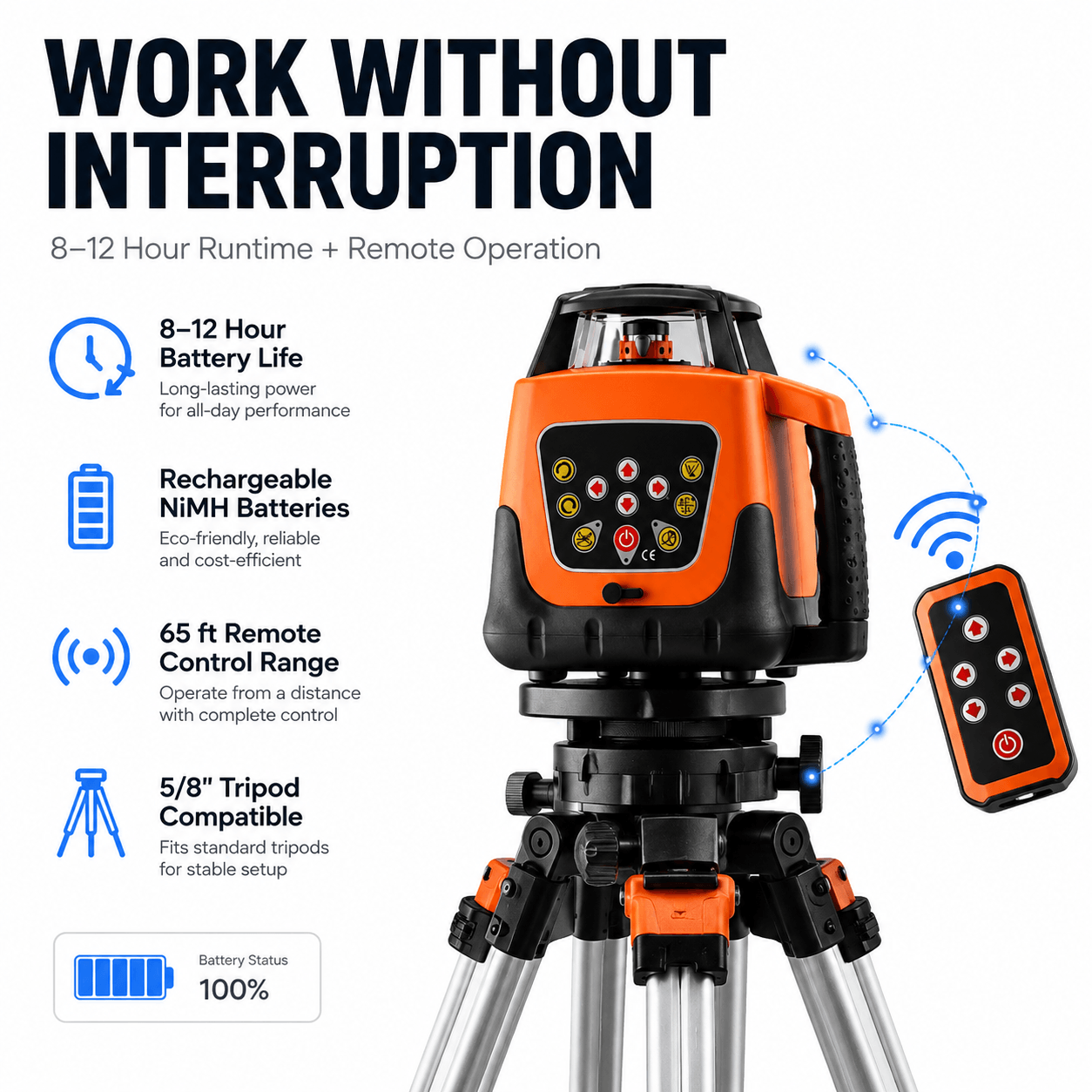
REMOTE CONTROL OPERATION FROM UP TO 65 FEET
Walking back and forth to the laser multiple times per hour quickly becomes frustrating on large projects.
The included remote control allows adjustments from up to 65 feet away.
Whether changing rotation speed, switching operating modes, or adjusting scan functions, operators can make changes without returning to the laser itself.
On larger sites, that translates directly into productivity.
A feature that seems minor in a specification sheet becomes surprisingly valuable during daily use.
IP66 PROTECTION FOR REAL JOBSITE CONDITIONS
Construction sites are rarely clean.
Equipment gets exposed to:
- Dust clouds from excavation
- Mud during grading
- Rain during site preparation
- Debris during foundation work
- Transportation between projects
This laser features IP66-rated protection and a high-impact composite housing built for outdoor use.
Direct Answer
IP66 means the housing is protected against heavy dust exposure and powerful water intrusion.
While no construction tool should be submerged or intentionally abused, this level of protection provides confidence in typical jobsite conditions.
8–12 HOURS OF CONTINUOUS OPERATION
The rechargeable power system uses four 1.2V NiMH batteries and delivers approximately 8–12 hours of runtime.
For most grading, excavation, and foundation projects, that's enough for a full workday.
Rechargeable batteries eliminate the recurring cost of disposable batteries while providing reliable field performance.
Direct Answer
Long battery runtime reduces interruptions during grading and site preparation work.
WHO THIS ROTARY LASER IS BEST FOR
Excavation Contractors
Verify cut and fill elevations quickly across large work areas.
Foundation Contractors
Maintain consistent footing and building pad elevations.
Concrete Contractors
Establish accurate form elevations before concrete placement.
Landscapers
Create controlled drainage slopes and finished grades.
Site Preparation Crews
Maintain elevation consistency throughout earthmoving operations.
Property Owners
Level acreage, driveways, drainage systems, and large outdoor projects with professional-grade accuracy.
TECHNICAL SPECIFICATIONS
| Specification | Value |
|---|---|
| Working Range | 1650 ft |
| Accuracy | ±1/16" at 100 ft |
| Self-Leveling Range | ±3° |
| Rotation Speeds | 0 / 60 / 120 / 300 / 600 RPM |
| Scan Angles | 5° / 45° / 90° / 160° |
| Detector Included | Yes |
| Remote Included | Yes |
| Remote Range | 65 ft |
| Battery Type | 4 × 1.2V NiMH |
| Runtime | 8–12 Hours |
| Protection Rating | IP66 |
| Tripod Mount | 5/8"-11 |
| Carrying Case Included | Yes |
Frequently Asked Questions
What is a rotary laser level used for?
A rotary laser level is used to establish a level reference plane across large outdoor areas for grading, excavation, drainage work, foundation preparation, and site layout.
Can this rotary laser level be used for grading?
Yes. It was specifically designed for grading and elevation control applications and includes both self-leveling and manual grade modes.
How accurate is this rotary laser?
The system provides ±1/16 inch accuracy at 100 feet.
Can I use this laser in bright sunlight?
Yes. The included detector allows reliable operation outdoors even when the beam itself is difficult to see.
Does the detector come included?
Yes. A laser detector is included with the system.
Is the remote control included?
Yes. The remote control is included and operates up to 65 feet away.
Is it compatible with construction tripods?
Yes. It uses the industry-standard 5/8"-11 tripod thread.
Is IP66 waterproof?
IP66 protection means the unit is protected against dust intrusion and powerful water exposure commonly encountered on construction sites.
How long does the battery last?
Expect approximately 8–12 hours of runtime depending on operating conditions.
What is the difference between a rotary laser and a line laser?
A rotary laser creates a full 360° reference plane for large outdoor projects, while a line laser projects visible lines primarily intended for shorter-range interior work.
For contractors performing grading, excavation, drainage installation, foundation preparation, and site development, the challenge is rarely creating a benchmark. The challenge is maintaining that benchmark accurately across an entire project.
This rotary laser level was built to solve exactly that problem.
Share