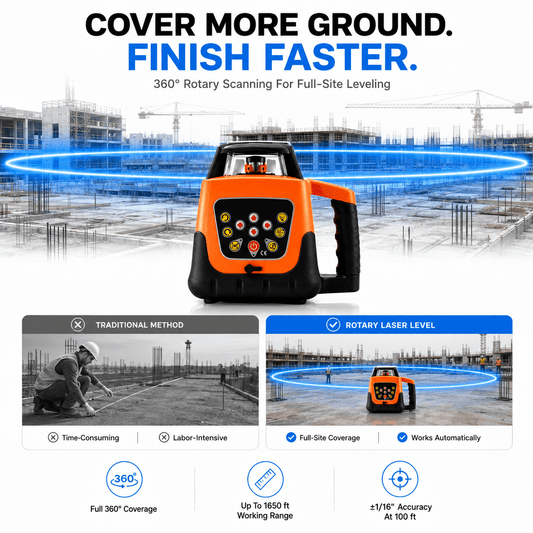
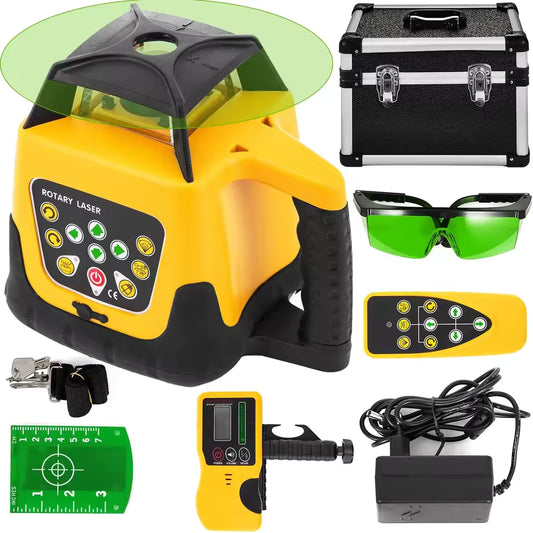
Rayxact Leveling rotary laser level
Rotary laser levels are the standard tool for exterior grading, slab elevation control, and site-wide layout on residential and light commercial builds across the US. This collection covers 12 rotating laser level models tested in real job site conditions, ranging from self leveling rotary laser level units accurate to ±3/32 inch at 100 feet to professional-grade spinning laser level systems readable at 2,600 feet with a compatible receiver. If your work is confined to a single room or interior walls, the cross-line collection fits your needs; if you are grading a pad, pouring a slab, or running elevation across an open site, start here. If you need to compare all laser level formats before committing to a category, the full laser level collection covers every type available on RayXact.
What to look for in a leveling rotary laser level
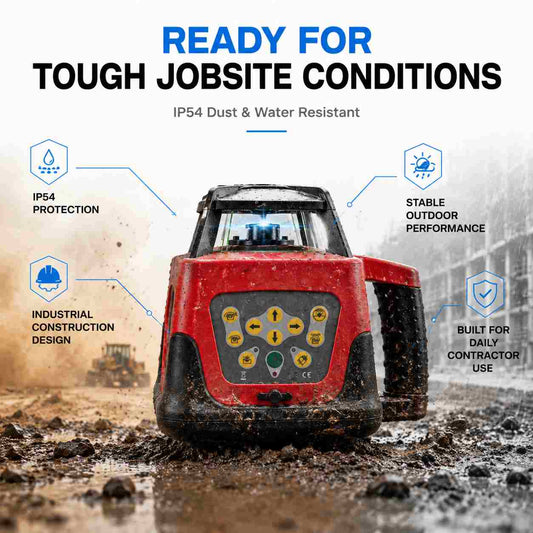
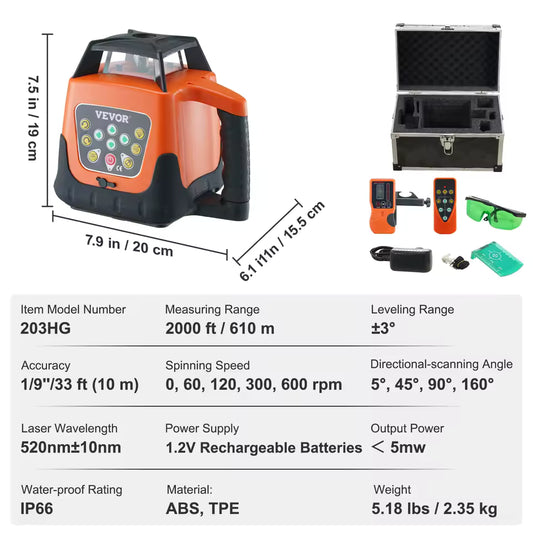
Three specifications separate a job-site-ready leveling rotary laser level from a unit that fails in the field: working range, self-leveling compensation angle, and IP rating. Working range determines whether the beam reaches a receiver across an open pad or stops short; most residential grading work demands at least 600 feet diameter with a detector, while slab and commercial site work routinely requires 1,000 feet or more. Self-leveling compensation angle matters because a unit with only a ±3-arc-minute range locks up and throws an out-of-level error on any surface with minor irregularities, whereas a ±10-arc-minute range handles typical tripod placement on uneven ground without manual adjustment. IP54 is the floor for intermittent outdoor exposure; IP66 and above is the correct specification for exposed grading and paving applications where direct water contact is a realistic daily condition.
Spinning laser level performance in the field
With 22 years of residential and light commercial work across the Mid-South, including slab pours, driveway grading, and pad prep for detached garages, I have found that a single degree of drift left undetected during setup translates to a 1-inch elevation error at 50 feet, which means a re-pour or a footing shim on the back end of a project. The models in this collection were selected specifically because their accuracy held within published spec across repeated setups on unlevel ground, in ambient temperatures from 28°F to 104°F, which are conditions I can actually replicate on job sites in Tennessee and surrounding states. Contractors who need to dial in a drainage grade or pipe invert before selecting a model will find the step-by-step process in the laser level slope setup guide on the RayXact blog.
Self leveling rotary laser level, three buyer profiles:
The right self leveling rotary laser level depends on the scale and frequency of your work, not on brand preference. If you are a concrete finisher or site contractor running elevation control across pads and slabs multiple days per week, you need a dual-grade capable unit with a 1,000-foot-plus working range and at least IP66 protection: the cost per project drops sharply when you eliminate rod-reading re-checks caused by beam washout. If you are a utility contractor or site supervisor running drainage grades, setting pipe inverts, or establishing elevation benchmarks across an open lot, you need a dual-grade unit with a working range of at least 800 feet, a ±10-arc-minute self-leveling range, and receiver compatibility that holds a stable reading at grade rod distances beyond 200 feet. If you are a serious DIYer pouring a backyard slab, building a deck footing, or grading a drainage channel once or twice a year, you need a single-grade unit with ±5-arc-minute self-leveling, a 300-foot working range with detector, and a carry case that protects the unit between uses. Contractor-grade rotating laser level models appear at the top of the grid; DIY-appropriate options are below.
Each rotating laser level in this collection was verified for accuracy using a calibrated reference rod at 50-foot, 100-foot, and 200-foot intervals, with readings taken across a minimum of three independent setups per model.
This collection was last reviewed against current OSHA laser safety classifications and ANSI Z136.1 standards: June 2026.
Common questions before you buy a laser rotating level:
Do I need a rotary laser level for indoor work, or is a cross-line model sufficient?
A rotary laser level is the correct choice when your working distance exceeds 60 feet, when you are outdoors, or when elevation control needs to extend across multiple planes simultaneously; interior room-to-room layout at shorter distances falls outside this collection's scope. For a side-by-side breakdown of format, range, and application fit, the
cross-line laser level collection covers the indoor use case in full.
When do I need a laser receiver with a rotary laser level?
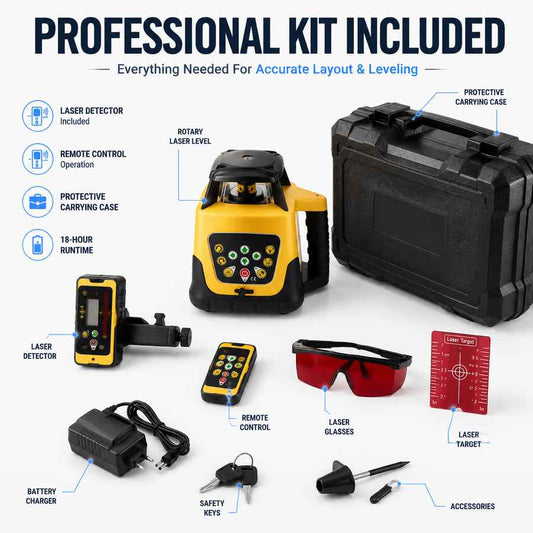
A laser receiver is required any time you are working in direct sunlight or at distances beyond roughly 100 feet, where ambient light exceeds the beam's visible intensity. Most spinning laser level models in this collection are sold with a compatible detector rated for use up to 2,600 feet; without a receiver outdoors, the beam is typically invisible past 30 to 50 feet under daylight conditions.
What self-leveling compensation angle should I look for in a rotary laser level?
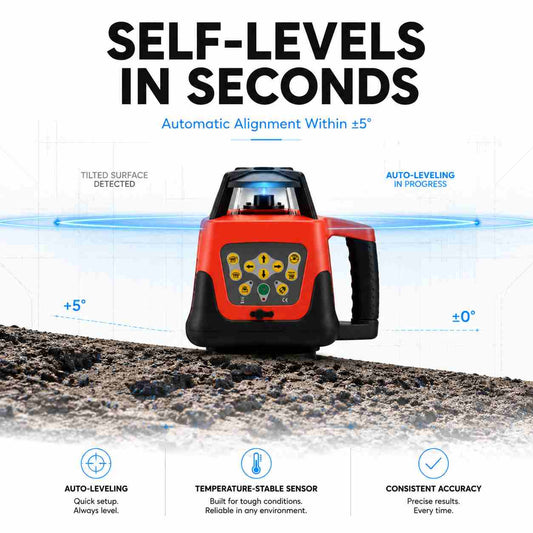
A self-leveling compensation angle of ±5 arc minutes is adequate for flat, prepared surfaces; ±10 arc minutes is the practical minimum for real job site conditions where the tripod sits on uneven ground, gravel, or a rough slab. Units with a compensation range below ±3 arc minutes will lock out and display an error during normal exterior setups, requiring manual leveling that adds setup time on every use.