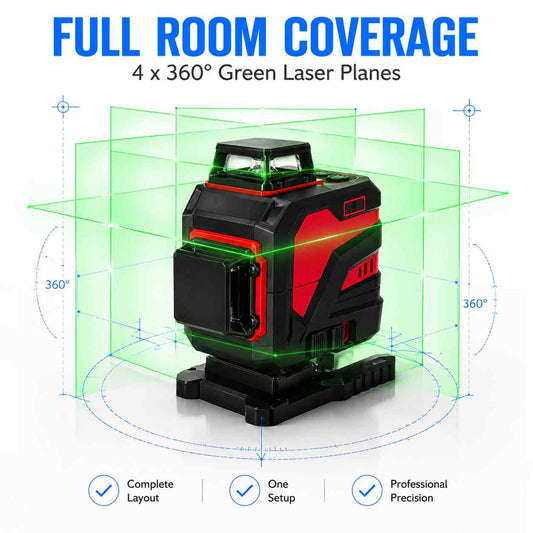
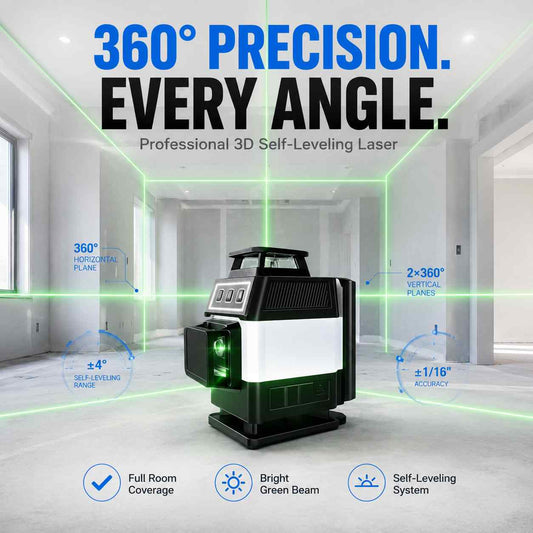
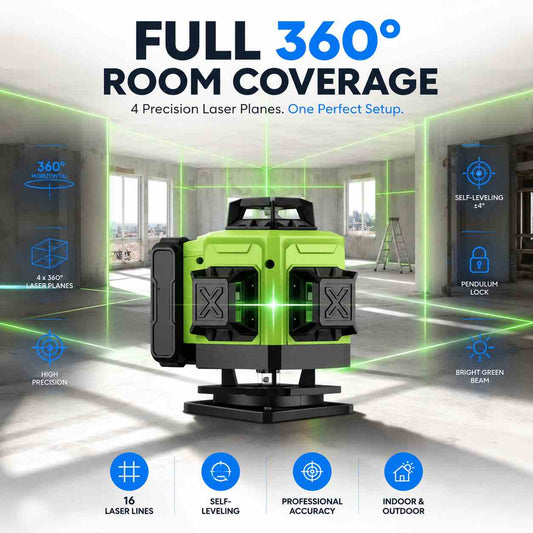
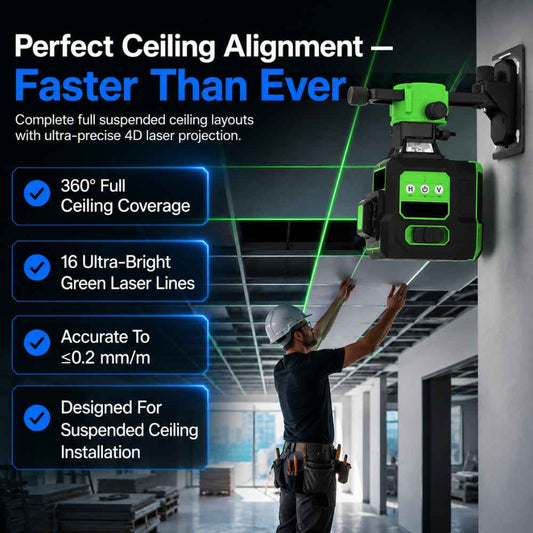
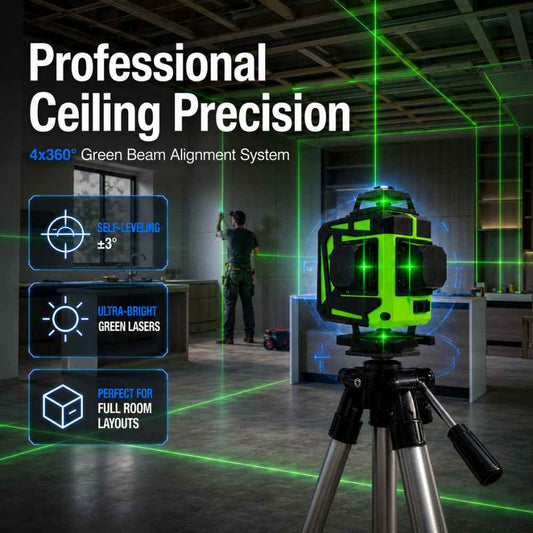
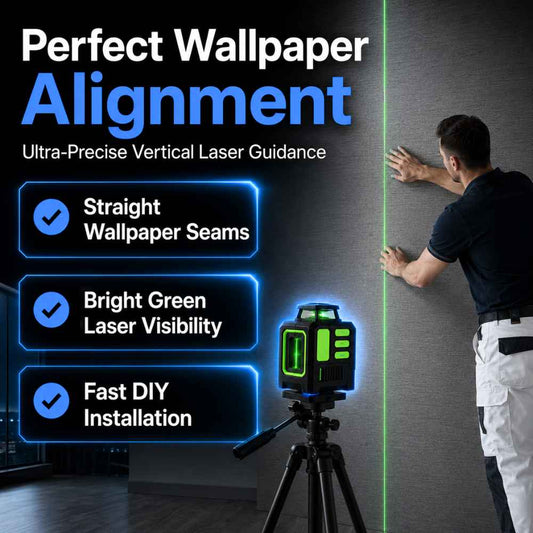
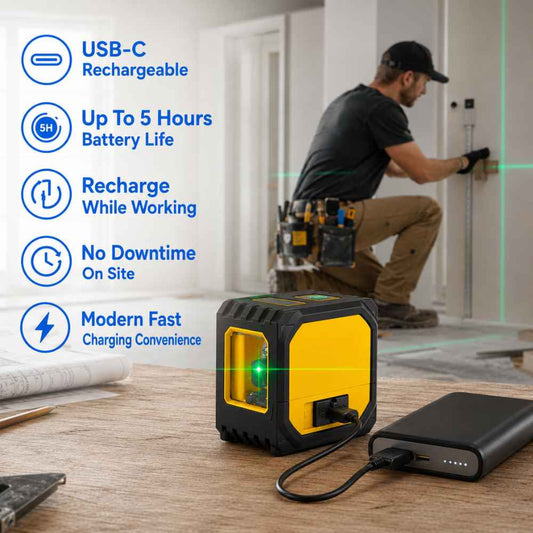
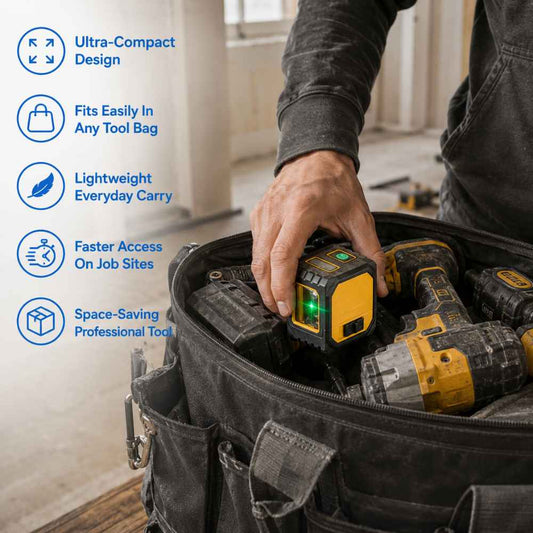
A laser level projects a beam of light to establish a precise horizontal or vertical reference line across a surface. Cross-line models cover interior rooms up to 65 feet; rotary models reach 300+ feet outdoors. Self-leveling laser levels lock a reference plane within ±4° in under 5 seconds. Skipping laser verification on a tile layout costs an average of $2,000 to $8,000 in rework. Green beam lasers (505–525 nm) are visible up to 4x farther than red in ambient daylight.
Last verified against OSHA laser safety standards and ANSI Z136.1: May 2026
Why laser level type determines your accuracy ceiling
I ran a bathroom tile job in Nashville two years ago where the GC handed a mid-range red beam level to a first-time installer. By the time the third wall was done, the grout lines had drifted 5/16 of an inch across 16 feet. Three days of work, $3,400 in material and labor, pulled and reset. The laser wasn't broken. The installer was reading a washed-out red beam in a lit room and compensating by eye. A green beam cross-line model would have given him a line he could trust.
That's the core issue with laser level selection: it's not about specs on paper. It's about whether the beam you can see in your actual working conditions is precise enough to stake a layout on.
Cross-line vs rotary vs dot laser levels
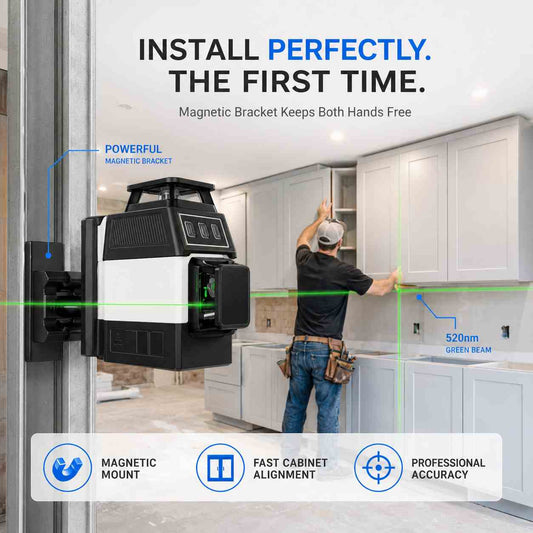
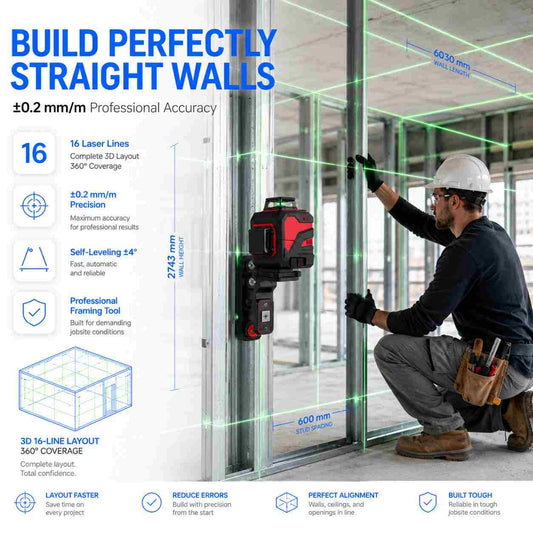
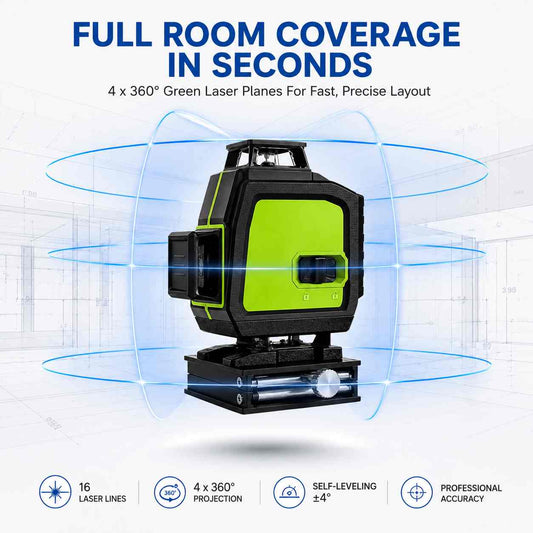
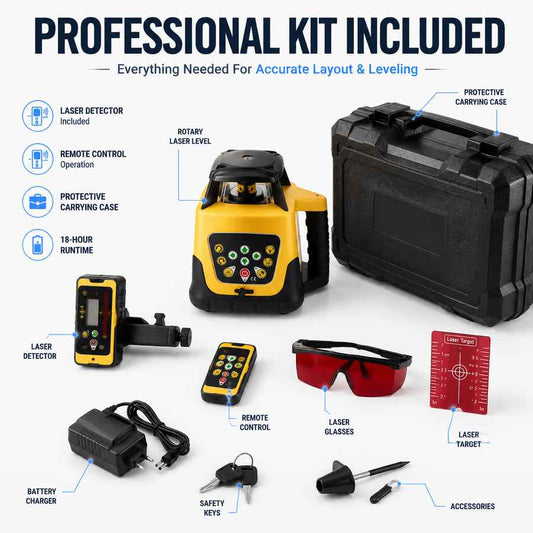
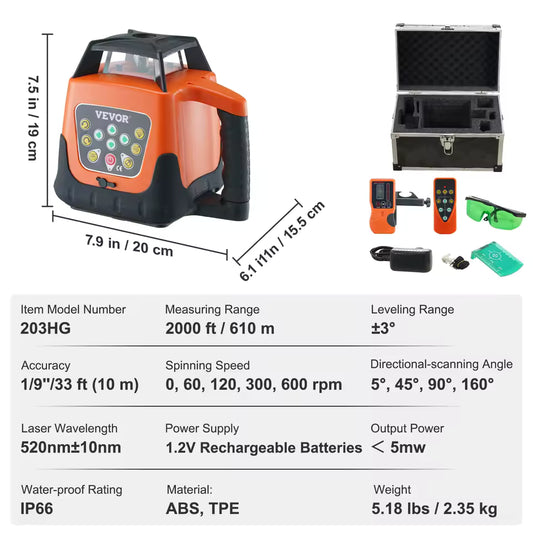
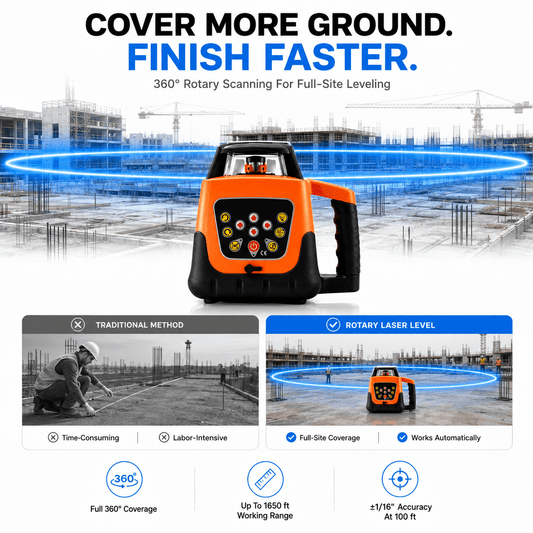
Cross-line lasers project one horizontal and one vertical line simultaneously. They cover interior rooms up to 65 feet without a detector and handle tile alignment, picture hanging, cabinet installation, and wall framing with no setup overhead. Rotary lasers spin the beam 360 degrees to create a full horizontal plane readable at 300+ feet outdoors, the tool of choice for concrete formwork, foundation layout, and site grading. Dot lasers project fixed plumb points used for column transfer and structural alignment where a continuous line would create confusion.
Type
Working range
Best use case
Outdoor capable
Price range
Cross-line indoor
20–65 ft
Tile, cabinets, wall layout
No (without detector)
$30–$120
Rotary outdoor
100–300+ ft
Grading, slab, formwork
Yes
$150–$400
Dot / plumb structural
15–30 ft
Column transfer, point layout
No
$40–$150
Green beam vs red beam laser levels
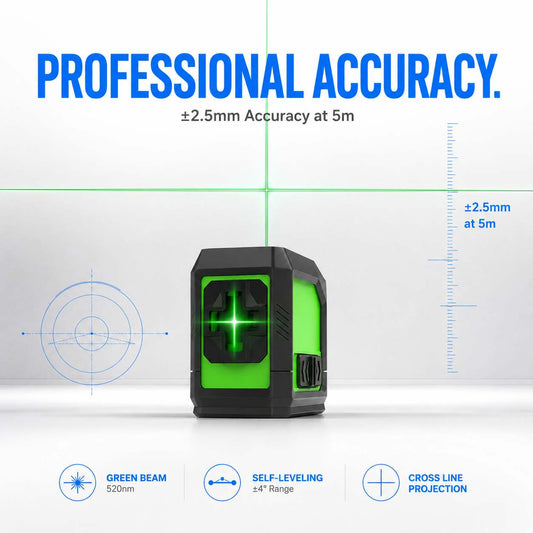
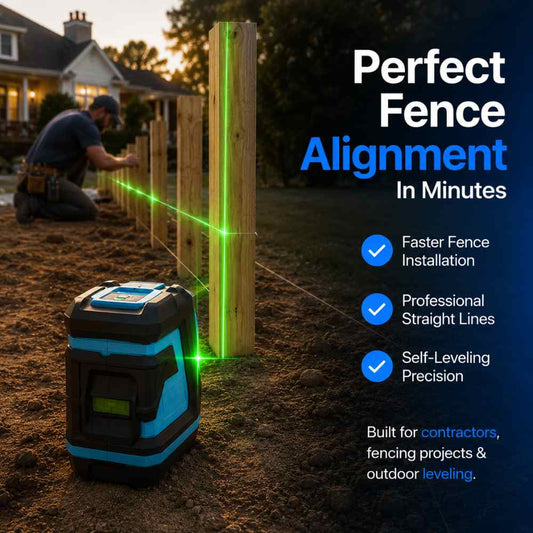
Green beam lasers emit at 505–525 nm, a wavelength the human eye perceives as significantly brighter than the 630–680 nm red spectrum under identical power output. In a daylit room, a green beam remains readable at 50–65 feet without a detector. A red beam fades to unreliable at 20–30 feet under the same conditions. The trade-off is battery life: green diodes draw more current and reduce runtime by 20–40% compared to equivalent red beam laser level.
For interior work, flooring, trim carpentry, electrical runs across lit rooms, green beam is the practical choice. For outdoor grading work where you're running a detector anyway, red beam's battery advantage matters more. Browse RayXact's green beam selection if your work is indoors or in mixed-light conditions.
Self-leveling vs manual laser levels:
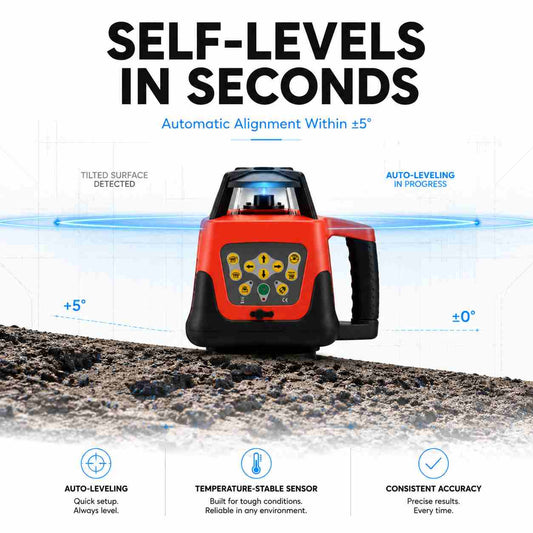
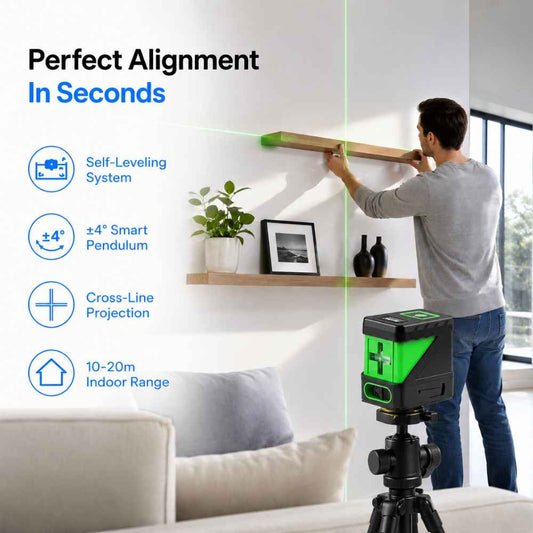
Self-leveling laser level use a magnetic pendulum dampened in fluid to find level within ±4° of plumb automatically. On a typical cross-line model, that process takes 3–5 seconds. If you set the tool on a surface inclined beyond that range, the beam flashes as an out-of-level warning rather than projecting a false line. Manual lasers fix the beam at whatever angle you set, useful for sloped drain layouts, stair stringer reference lines, and raked ceiling work where true level is not the goal.
If you're using a self-leveling laser level with tripod and the beam flashes on what looks like a flat surface, stop before you mark anything. On a Phoenix slab job last August, we caught a 3/8-inch variation in a poured floor that way, the slab had settled unevenly and the floor looked flat to the eye. The flashing beam saved two days of tile layout.
Pro tip from a construction layout specialist
Lock the pendulum before moving any self-leveling laser, even across the same room. One drop from a 3-foot tripod can shift calibration by ±0.3 degrees, invisible on a bubble check, visible as a 1/4-inch error across a 20-foot ceiling grid.
Accuracy requirements by application
Not every job needs the same tolerance. Tile work is the most demanding interior application, a 1/16-inch drift per 10 feet compounds into visible misalignment across a full bathroom wall. Suspended ceiling grids tolerate slightly more variance. Exterior grading, governed by ASTM E1155 concrete slab flatness standards, requires a rotary laser with a detector to hit the FF25/FL20 minimum on a pour.
Application
Laser type
Required accuracy
Working range
Tile / flooring
Cross-line green
±1/16 in per 10 ft
Up to 40 ft
Suspended ceiling grid
Cross-line or rotary
±1/8 in per 20 ft
Up to 65 ft
Exterior grading / formwork
Rotary with detector
±1/4 in per 100 ft
100–300 ft
Framing / stud layout
Cross-line or dot
±1/8 in per 8 ft wall
Up to 30 ft
Concrete slab flatness (ASTM E1155)
Rotary
FF25/FL20 minimum
Full slab
Which laser level do you actually need?
Start with where you work. If every job is indoors under 65 feet, a green beam cross-line laser with a self-leveling pendulum covers 90% of what you'll encounter. If you're working outdoors on grading or foundation work, a rotary with a compatible detector is the only tool that gives you readable lines at distance. If you do both, a cross-line for interiors and a rotary for site work is the practical split, trying to use a cross-line outdoors without a detector consistently produces misreads beyond 20 feet in daylight.
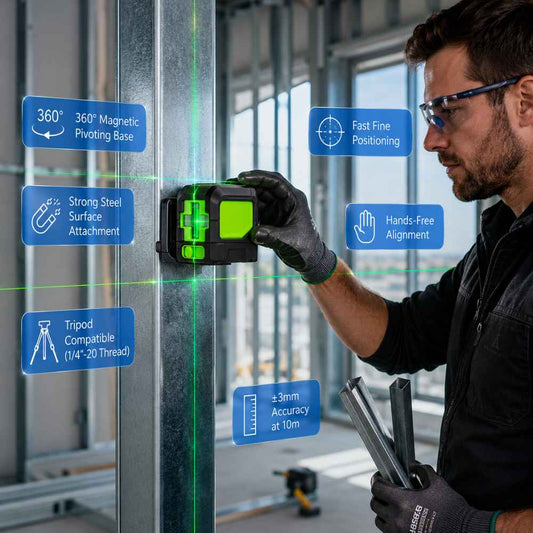
For DIY renovators doing wall work, cabinet installs, or floating shelf runs, any green beam cross-line model with a 1/4"-20 tripod thread gives you the flexibility to mount at height and work hands-free. That single feature, the standard tripod thread, is what separates a layout tool from a gimmick.
How to choose from the Laser level collection?
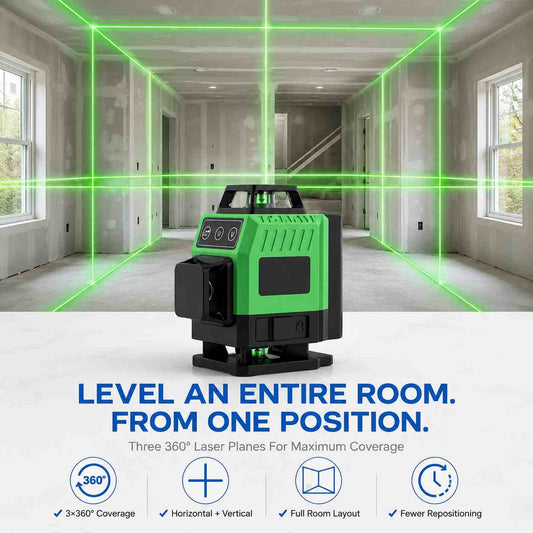
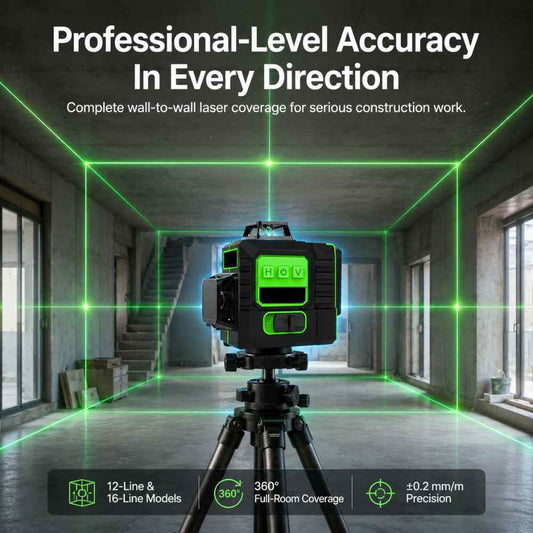
Filter by beam type first, green or red. Then by line count: 2-line cross models for general layout, 3-line or 360-degree models if you're squaring rooms or setting full-wall tile. Finally check the leveling range: ±4° handles most real-world surfaces, but if your subfloor is significantly out or you're working on sloped concrete, look for a model with a wider self-leveling range or a manual mode.
Every product page lists laser class per ANSI Z136.1 and working distance under indoor conditions. Class 2 is standard for cross-line consumer and pro models at under 1mW, safe for momentary exposure. Class 3R units used in some rotary models require more care on shared job sites per OSHA 29 CFR 1926.54. If you're running a rotary on a commercial site with other trades present, that distinction matters for your safety plan.
All RayXact laser levels ship with spec sheets listing working range, beam class, and leveling tolerance. If a spec isn't listed, we don't carry the product.
Updated: May 2026
Frequently Asked Questions about laser level:
A spec of ±1/16 inch per 10 feet means the laser beam can deviate up to 1/16 inch above or below true level at a distance of 10 feet. At 20 feet, that tolerance doubles to ±1/8 inch; at 40 feet, it reaches ±1/4 inch if not rechecked. For tile and finish flooring, ±1/16 inch per 10 feet is the practical ceiling — drift above that threshold produces visible grout line misalignment across a full wall. For framing and stud layout, ±1/8 inch per 8-foot wall is acceptable. Every product page in this collection lists the working accuracy under indoor conditions so you can match the spec to your application before purchasing.
For interior work in lit rooms, yes. A green beam at 505–525 nm remains readable at 50–65 feet without a detector; a red beam fades to unreliable at 20–30 feet under the same conditions. The trade-off is 20–40% shorter battery life on green diodes compared to equivalent red models. If your work is predominantly outdoor grading or low-light interior work where you run a detector regardless, red beam's battery advantage is the better value. If you are doing tile layout, cabinet runs, or ceiling grid work in a daylit room, the visibility difference justifies the cost difference at every price tier in this collection.
If the surface tilt exceeds the laser's self-leveling range — typically ±4° on most cross-line models — the beam flashes as an out-of-level warning instead of projecting a reference line. This is a safety feature, not a malfunction: the tool refuses to project a false line rather than give you a reading you cannot trust. If your subfloor or work surface is out beyond ±4°, you have three options: shim the base to bring it within range, use a laser level tripod with independently adjustable legs to compensate, or select a model with a wider self-leveling range. Some units in this collection also include a manual mode for intentional slope work such as stair stringers and raked ceilings.
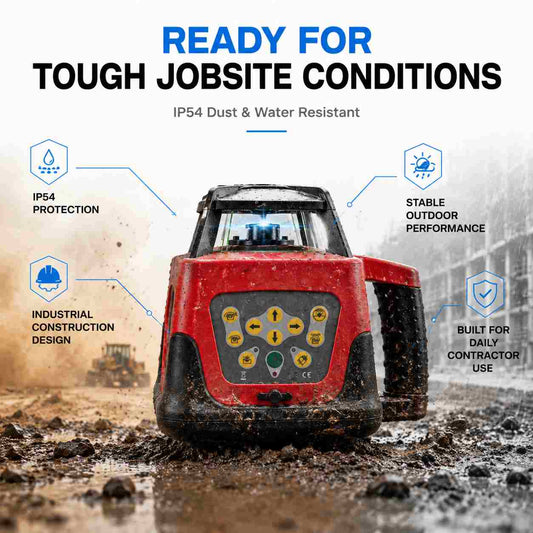
For any outdoor or mixed-environment use, an IP54 rating is the practical minimum. IP54 protects against dust ingress and water spray from any direction — adequate for most residential and light commercial job sites in normal weather. IP65 adds full dust-tight protection and low-pressure water jets, relevant if you are working near concrete pours, pressure washing, or in sustained rainfall. Models below IP54 are rated for interior use only; moisture entering the housing through the lens or battery compartment on a wet slab will damage the pendulum mechanism and shift calibration without visible warning. Each product page in this collection lists the IP rating alongside the laser class and working range.
Class 2 laser levels emit under 1 mW of continuous output and are safe for momentary accidental eye exposure — the natural blink reflex provides adequate protection under ANSI Z136.1. Class 3R units emit 1–5 mW and require additional caution: direct beam exposure for more than a fraction of a second carries risk of retinal injury. On a shared commercial job site with multiple trades present, OSHA 29 CFR 1926.54 requires a written laser safety plan for Class 3R and above. Cross-line models in this collection are Class 2. Rotary models with extended outdoor range may be Class 3R — confirm the laser class on the product page before deploying on a site with other workers in the beam path.
Choosing a selection results in a full page refresh.