


RayXact
Laser level for drop ceiling | ProGrid 4D
Laser level for drop ceiling | ProGrid 4D
Couldn't load pickup availability
What a Suspended Ceiling Laser Level with 16 Lines Actually Changes on a Large-Format Job:
A ceiling grid running 3 mm out of plane across a 200 m² commercial fit-out is not visible to the eye at setup. It shows up three days later when the tile cuts start drifting and the perimeter trim refuses to sit flush. The ProGrid 4D projects 16 green laser lines simultaneously: one full 360° horizontal plane and two double-sided vertical planes firing at once, so every wall, corner, and overhead reference is live at the same time from a single placement.
No repositioning to check a second axis. No dry-run measurements at the four corners before committing the main grid. The unit auto-levels on startup within a ±3° compensation range, locking the beam to within 0.2 mm per meter from the moment the pendulum settles, which takes seconds, not minutes.
For a solo installer working across a floor plate where the structural ceiling varies by 40 mm over its span, that consistency is not a convenience; it is the difference between a grid that absorbs the variation invisibly and one that telegraphs it through every tile row.
Spec-to-Situation: What Each ProGrid 4D Capability Covers on a Drop Ceiling Job
- ● 16 green lines, 360° horizontal + dual vertical planes simultaneously: marks all four walls and the ceiling plane in one setup, no secondary placement needed to confirm the cross-axis on a wide bay.
- ● ±0.2 mm/m leveling accuracy, auto-compensates within ±3°: absorbs minor floor surface variation under the tripod without manual shimming, which matters in pre-poured industrial slabs that appear flat.
- ● 30-meter outdoor visibility + included remote control: allows a single installer to verify perimeter wall marks from across a large open-plan floor without repositioning the unit or walking back to adjust.
- ● 2-second hold activates manual oblique/tilt mode: projects angled reference lines for raked soffits, stair-adjacent ceiling sections, or any sloped drop ceiling plane where auto-level would give a false horizontal.
- ● 360° rotating head included in kit: repositions beam direction from the floor via remote when the unit is mounted high on a wall bracket, eliminating ladder climbs between layout adjustments in rooms above 3 meters.
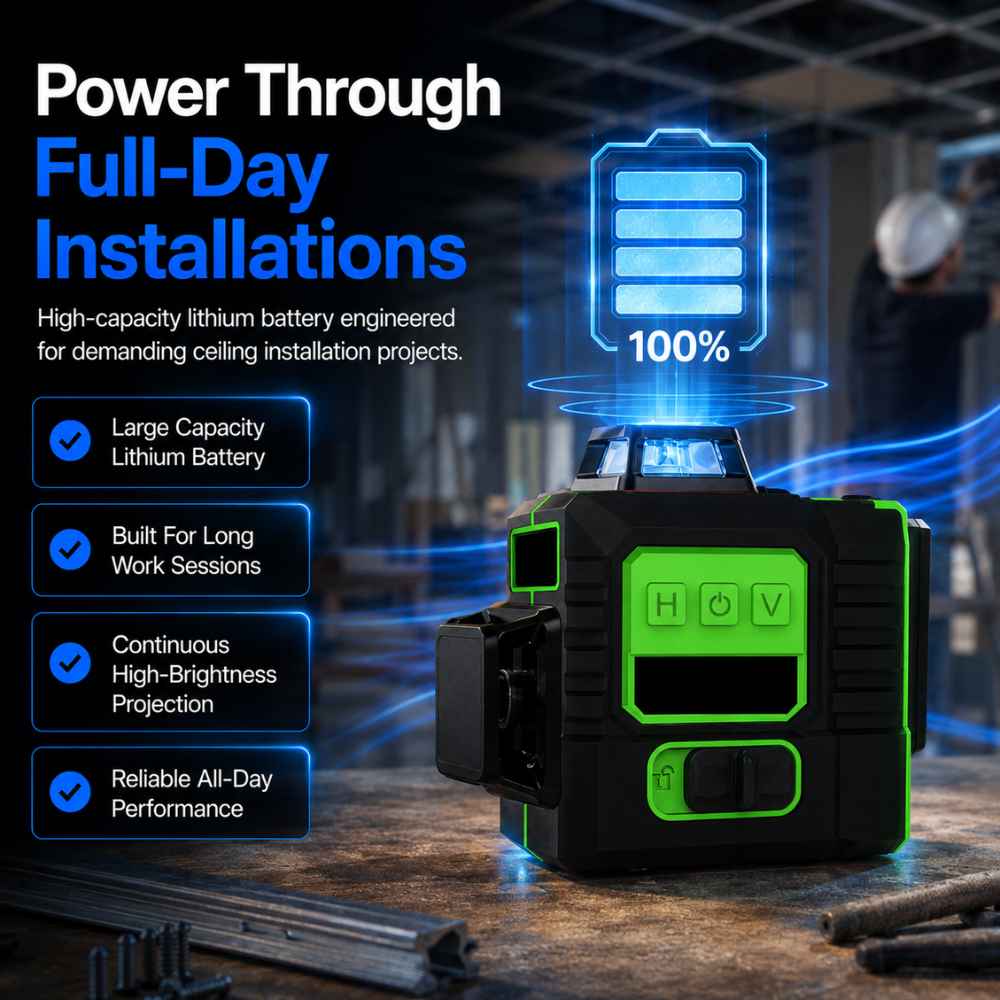
- ● Built-in lithium battery, full-session capacity: sustains high-brightness green beam output across a full installation day, critical for a suspended ceiling grid where stopping mid-layout to recharge breaks reference continuity.
How the 4D Projection Spec Translates to Real Drop Ceiling Grid Alignment Outcomes:
The ProGrid 4D laser level projects 16 green lines across a full 360° horizontal plane plus dual-sided vertical planes simultaneously, self-leveling to an accuracy of 0.2 mm per meter within a ±3° tilt compensation range, with a beam visibility of 30 meters outdoors, making it measurably suited for large open-bay suspended ceiling installations without the need for repeated repositioning.
I have set ceiling grids in open commercial spaces where the only way to hold the reference line steady at the far wall was to use the remote from 18 meters out while marking, because walking back to adjust the unit each time broke the mark registration on the wall. The rotating head on this unit makes that workflow repeatable without an assistant.
The Tilt Mode Spec That Separates a Ceiling Laser Level from a General-Purpose Cross-Line Tool:
A 2-second hold switches the ProGrid 4D out of auto-level mode and into manual oblique scanning, which disengages the pendulum lock and lets you project a tilted plane at any arbitrary angle. For standard drop ceiling work on a flat structural deck, you will never need this. But suspended ceilings that follow a sloped architectural soffit, stair-adjacent grid sections, or any installation where the designer has specified a raked ceiling plane require exactly this function, and it is not present on basic cross-line lasers that only self-level.
The ability to draw a consistent angled reference across a stairwell or a sloped entryway without reverting to chalk lines and manual measurements cuts what would be a two-person, half-day layout down to a single-person morning task. The built-in lithium battery supports a full session without interruption; battery capacity is not specified in exact mAh by the manufacturer, but the design intent is explicitly stated as eliminating mid-job recharge stops.
The kit ships with the laser unit, remote control, charger, two adapters, wall bracket, rotating head, and an Oxford carry bag, everything needed to go from unboxing to a live reference line on a commercial ceiling without a separate hardware run. Explore the full laser level range or pair this unit with a compatible laser level tripod for elevated center-room placements on high-bay installations.
When the Ceiling Grid Spec Leaves No Room for a Second Pass?
A suspended ceiling that passes visual inspection at installation and fails dimensional tolerance at punch-list costs more in rework than the tool that would have caught the drift at layout. The 0.2 mm/m accuracy, 360° simultaneous output, and remote-controlled 30-meter reach of the ProGrid 4D address each compounding variable that makes large-format ceiling grids go wrong, before the first main runner is hung. That is the spec set worth verifying against your next project scope.
Share


FAQ - Laser level
What is a laser level and how does it work?
A laser level projects a beam of coherent light to establish a precise horizontal or vertical reference line across a surface. Self-leveling models use a magnetic pendulum dampened in fluid to find level automatically within ±4° of plumb a process that takes 3 to 5 seconds on most cross-line units.
If you place the tool on a surface inclined beyond that range, the beam flashes as an out-of-level warning rather than projecting a false line. This is a critical safety feature. Cross-line models cover interior rooms up to 65 feet without a detector. Rotary models spin the beam 360 degrees and reach 300+ feet outdoors with a compatible detector.
Is a green beam laser level worth the extra cost over a red beam?
For interior work in lit rooms, yes. Green beams emit at 505–525 nm a wavelength the human eye perceives as significantly brighter than the 630–680 nm red spectrum at identical power output. In a daylit room:
Green beam: stays readable at 50–65 feet without a detector
Red beam: fades to unreliable at 20–30 feet under the same conditions
The trade-off is battery life: green diodes draw more current and reduce runtime by 20–40% vs equivalent red models. For outdoor grading where you run a detector regardless, red beam's battery advantage matters more. For tile layout, cabinet runs, drop ceiling grids, and any daylit interior room, green beam justifies its cost at every price tier in the RayXact catalog.
What is RayXact's return and refund policy?
RayXact offers a 30-day return policy from the date of purchase. To be eligible, the item must be:
Unused and in its original condition
In original packaging
Accompanied by a receipt or proof of purchase
Email contact.rayxact@gmail.com first to receive the return address and instructions. Return shipping costs are the customer's responsibility and non-refundable.
For defective or damaged items, RayXact will exchange the product for the same item contact support by email to begin the exchange process. Approved refunds are credited to the original payment method within a certain number of business days after the returned item is received and inspected.