


RayXact
Pocket laser level | PocketBeam
Pocket laser level | PocketBeam
Couldn't load pickup availability
Why Most Indoor Alignment Jobs Fail Before the First Line Is Drawn and this Pocket laser level don't
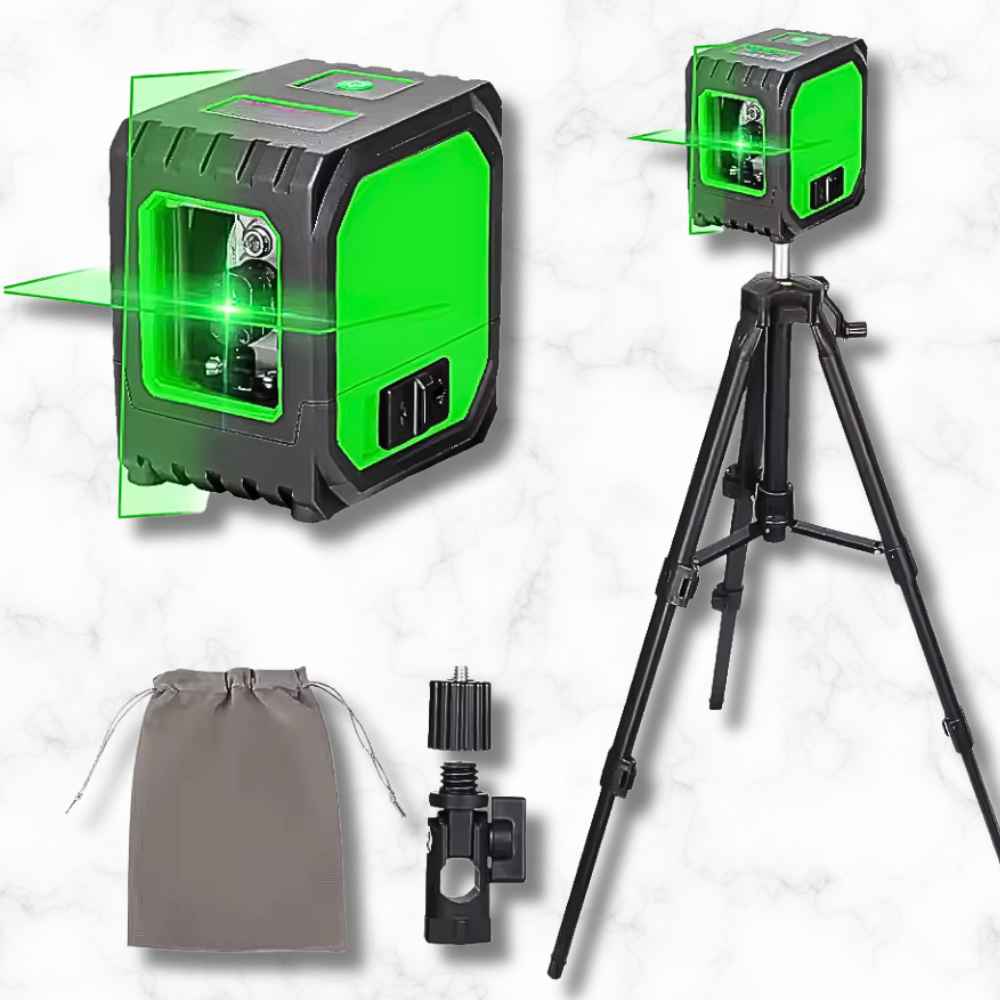
The mistake happens during setup: a surface that reads level to the eye, or to a 4-inch bubble vial, conceals a cross-slope that only shows up two-thirds of the way down a cabinet run or a tile wall. By then the grout lines are already wrong, and fixing it means pulling work that took hours. The PocketBeam solves this at the start of the job, not the end. Its dual-axis green laser projects one horizontal and one vertical line simultaneously, visible indoors up to 20 meters, so the full working surface is referenced before a single fastener goes in. The intelligent pendulum self-levels automatically within 3 seconds of placement and flashes a warning if the surface tilt exceeds the leveling range, which means there is no silent failure mode and no ambiguity about whether the reading is valid.
Spec-to-Situation: When Each Power Mode Does the Work
- ● USB-C charging, 5-hour runtime: Use this mode for full-day cabinet installs, tile layout runs, or multi-room framing inspections where a power bank or outlet is within reach at lunchtime.
- ● AAA battery backup, hot-swap capable: Use this mode when you are mid-run in a crawl space, an attic, or a room without power access and cannot interrupt the reference line. Swap batteries without repositioning the tool.
- ● 1/4-inch thread mount, tripod or magnetic stand: Use this mode for extended layout sessions on long walls or ceilings where a fixed, hands-free reference line lets one person do the work of two.
- ● Pocket carry, one-hand placement: Use this mode for quick verification tasks between larger tasks: checking a door frame, confirming a shelf bracket, or validating a horizontal run before committing to adhesive.
How a Green Cross-Line Pocket level with Laser at 20 Meters Changes the Sequence of an Indoor Layout Job
The PocketBeam pocket laser level projects a bright green cross-line beam visible indoors up to 20 meters, self-leveling within a 3-degree range of surface tilt, making it suitable for single-operator tile, trim, and cabinetry installations without a second person holding a reference point. Green laser diodes register roughly four times brighter to the human eye than red at equivalent power output, which is why the beam stays readable across an open-plan room without a detector. On a mid-size kitchen installation, the horizontal line spans the entire wall in one placement, removing the step of repositioning or stitching reference marks from multiple points. I have set this tool on a plywood workbench scrap in a dimly lit garage and had the cross-line read cleanly from the far wall at the stated distance, without any ambient light adjustment. The pendulum locks for transport and unlocks instantly on the next placement, so moving from room to room mid-job does not add any calibration overhead between setups.
What the 1/4-Inch Thread and Pocket Form Factor Give Back in Time on a Real Workday?
At pocket size with a 1/4-inch threaded base, the PocketBeam fits on any standard camera tripod, magnetic tool stand, or drywall hook, which means the reference line can be positioned at any height on a wall without a second tool or an improvised stack of lumber. The body goes into a jacket pocket between setups and comes out in one hand, already pointed at the work surface. On a day with three or four different rooms or zones, that mobility is the margin between finishing on schedule and not. Laser Class 2 rating applies: the beam is safe under normal use conditions but direct viewing into the aperture is not permitted, consistent with all cross-line laser tools in this category.
The Measurement That Ends the Guesswork on Wall and Floor Layout
A cabinet run, a tile grid, or a trim line that looked straight by eye but wasn't is a costly correction. The 20-meter green cross-line and the 3-second self-level resolve the reference before work starts, not after. One placement, one operator, one read.
Share


FAQ - Laser level
What is a laser level and how does it work?
A laser level projects a beam of coherent light to establish a precise horizontal or vertical reference line across a surface. Self-leveling models use a magnetic pendulum dampened in fluid to find level automatically within ±4° of plumb a process that takes 3 to 5 seconds on most cross-line units.
If you place the tool on a surface inclined beyond that range, the beam flashes as an out-of-level warning rather than projecting a false line. This is a critical safety feature. Cross-line models cover interior rooms up to 65 feet without a detector. Rotary models spin the beam 360 degrees and reach 300+ feet outdoors with a compatible detector.
Is a green beam laser level worth the extra cost over a red beam?
For interior work in lit rooms, yes. Green beams emit at 505–525 nm a wavelength the human eye perceives as significantly brighter than the 630–680 nm red spectrum at identical power output. In a daylit room:
Green beam: stays readable at 50–65 feet without a detector
Red beam: fades to unreliable at 20–30 feet under the same conditions
The trade-off is battery life: green diodes draw more current and reduce runtime by 20–40% vs equivalent red models. For outdoor grading where you run a detector regardless, red beam's battery advantage matters more. For tile layout, cabinet runs, drop ceiling grids, and any daylit interior room, green beam justifies its cost at every price tier in the RayXact catalog.
What is RayXact's return and refund policy?
RayXact offers a 30-day return policy from the date of purchase. To be eligible, the item must be:
Unused and in its original condition
In original packaging
Accompanied by a receipt or proof of purchase
Email contact.rayxact@gmail.com first to receive the return address and instructions. Return shipping costs are the customer's responsibility and non-refundable.
For defective or damaged items, RayXact will exchange the product for the same item contact support by email to begin the exchange process. Approved refunds are credited to the original payment method within a certain number of business days after the returned item is received and inspected.