


RayXact
Laser level for wallpapering | WallBeam
Laser level for wallpapering | WallBeam
Couldn't load pickup availability
Why Wallpaper Seams Drift on Walls That Look Plumb, and What a Vertical Laser Reference Changes?
The first strip of wallpaper on any room sets the tolerance for every strip that follows. A starting edge hung 2 mm off true vertical compounds across a full wall: by strip six or seven, the pattern repeat has shifted visibly and the seam at the corner arrives at a mismatched angle that no amount of trimming corrects cleanly. Using a plumb bob or a spirit level to mark a starting line takes time, leaves a pencil mark on fresh plaster, and still introduces human error at the moment of transfer.
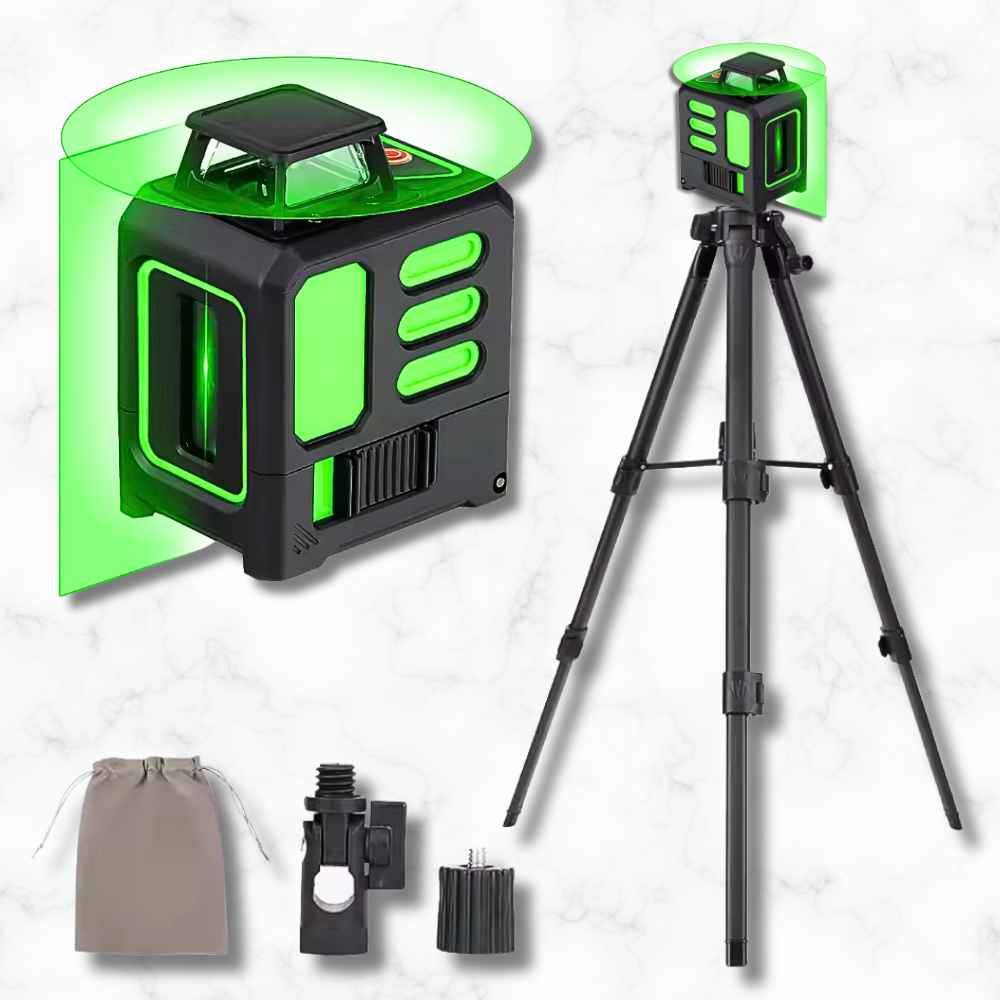
A laser level for wallpapering eliminates the transfer step entirely. The WallBeam projects a green vertical line that lives on the wall surface continuously, so the first strip is hung directly against a live optical reference rather than against a mark made minutes earlier. The green beam covers floors, walls, and ceilings around the room from a single placement, which means the reference line is available at full height, from skirting to cornice, without repositioning the unit between strips.
What the Green Cross-Line Catches Before the Wallpaper Goes Up
- ● A starting edge that is not truly plumb: the vertical green line exposes a wall surface that appears straight to the eye but runs 2 to 3 mm off vertical over ceiling height, which would shift the seam line progressively across every subsequent strip.
- ● A corner angle that is not 90°: the 90° cross-line intersection confirms whether the adjacent wall meets at true perpendicular before the first strip is committed to adhesive, allowing the starting position to be adjusted rather than discovered at the corner return.
- ● Pattern repeat drift caused by a sloped ceiling line: the horizontal laser reference at ceiling height makes a sloped cornice visible as a measurable gap rather than a visual impression, so the first strip drop can be adjusted before the repeat registers incorrectly against the ceiling line.
- ● Loss of the vertical reference between strips on a long wall: the beam projects continuously across the full wall surface, so the seam guide is live for every strip in sequence without remarking or repositioning the unit between each paste-and-hang cycle.
- ● A pencil mark that damages fresh plaster or lining paper: the laser reference replaces the physical wall mark entirely, leaving no surface contact on the substrate before the wallpaper adhesive is applied.
- ● A reference line that is unreadable against pale wallpaper backgrounds in daylight: the green beam wavelength remains visible against white lining paper and off-white vinyl substrates under normal indoor lighting, where a red beam at comparable output would require the room to be dimmed to stay readable.
How the 90° Green Cross-Line Spec Handles the Two Surface Conditions That Break Wallpaper Alignment:
The WallBeam wallpaper laser level projects horizontal and vertical green lines that intersect at a guaranteed 90° angle, with automatic self-leveling and a green beam wavelength that reads clearly on painted plaster, lining paper, and bare drywall surfaces under normal indoor lighting conditions.
That 90° intersection is the operative spec for wallpapering: it confirms that the vertical seam reference and the horizontal pattern-height reference share a common perpendicular origin, so a patterned wallpaper with a large repeat can be cut to height against a line that is geometrically consistent with the drop reference on the wall. The two surfaces that most often break wallpaper alignment are walls that bow slightly outward at mid-height (common in older plasterwork) and corners where two walls meet at slightly more or less than 90°.
For rooms where the distance from the unit to the working wall exceeds the comfortable naked-eye range of a 2-line model, mounting the WallBeam on a compatible laser level with tripod raises the projection center to wall mid-height and stabilizes the beam against floor vibration from foot traffic during a working session. Browse the full laser level range to compare line count and beam configurations if the room layout requires horizontal references at multiple heights simultaneously.
Laser level wallpapering, Before the First Strip Goes Up, the Vertical Reference Has to Be Set Correctly:
A seam that drifts from plumb on strip one cannot be corrected on strip four. The 90° green cross-line reference and the continuous projection across the full wall height address that constraint at the moment it matters, before adhesive is applied. Select the kit that matches the session length and the wall height, and the starting line holds.
Share


FAQ - Laser level
What is a laser level and how does it work?
A laser level projects a beam of coherent light to establish a precise horizontal or vertical reference line across a surface. Self-leveling models use a magnetic pendulum dampened in fluid to find level automatically within ±4° of plumb a process that takes 3 to 5 seconds on most cross-line units.
If you place the tool on a surface inclined beyond that range, the beam flashes as an out-of-level warning rather than projecting a false line. This is a critical safety feature. Cross-line models cover interior rooms up to 65 feet without a detector. Rotary models spin the beam 360 degrees and reach 300+ feet outdoors with a compatible detector.
Is a green beam laser level worth the extra cost over a red beam?
For interior work in lit rooms, yes. Green beams emit at 505–525 nm a wavelength the human eye perceives as significantly brighter than the 630–680 nm red spectrum at identical power output. In a daylit room:
Green beam: stays readable at 50–65 feet without a detector
Red beam: fades to unreliable at 20–30 feet under the same conditions
The trade-off is battery life: green diodes draw more current and reduce runtime by 20–40% vs equivalent red models. For outdoor grading where you run a detector regardless, red beam's battery advantage matters more. For tile layout, cabinet runs, drop ceiling grids, and any daylit interior room, green beam justifies its cost at every price tier in the RayXact catalog.
What is RayXact's return and refund policy?
RayXact offers a 30-day return policy from the date of purchase. To be eligible, the item must be:
Unused and in its original condition
In original packaging
Accompanied by a receipt or proof of purchase
Email contact.rayxact@gmail.com first to receive the return address and instructions. Return shipping costs are the customer's responsibility and non-refundable.
For defective or damaged items, RayXact will exchange the product for the same item contact support by email to begin the exchange process. Approved refunds are credited to the original payment method within a certain number of business days after the returned item is received and inspected.